
Unitree As2
Unitree As2 moves the compact quadruped category toward tougher mobile work.
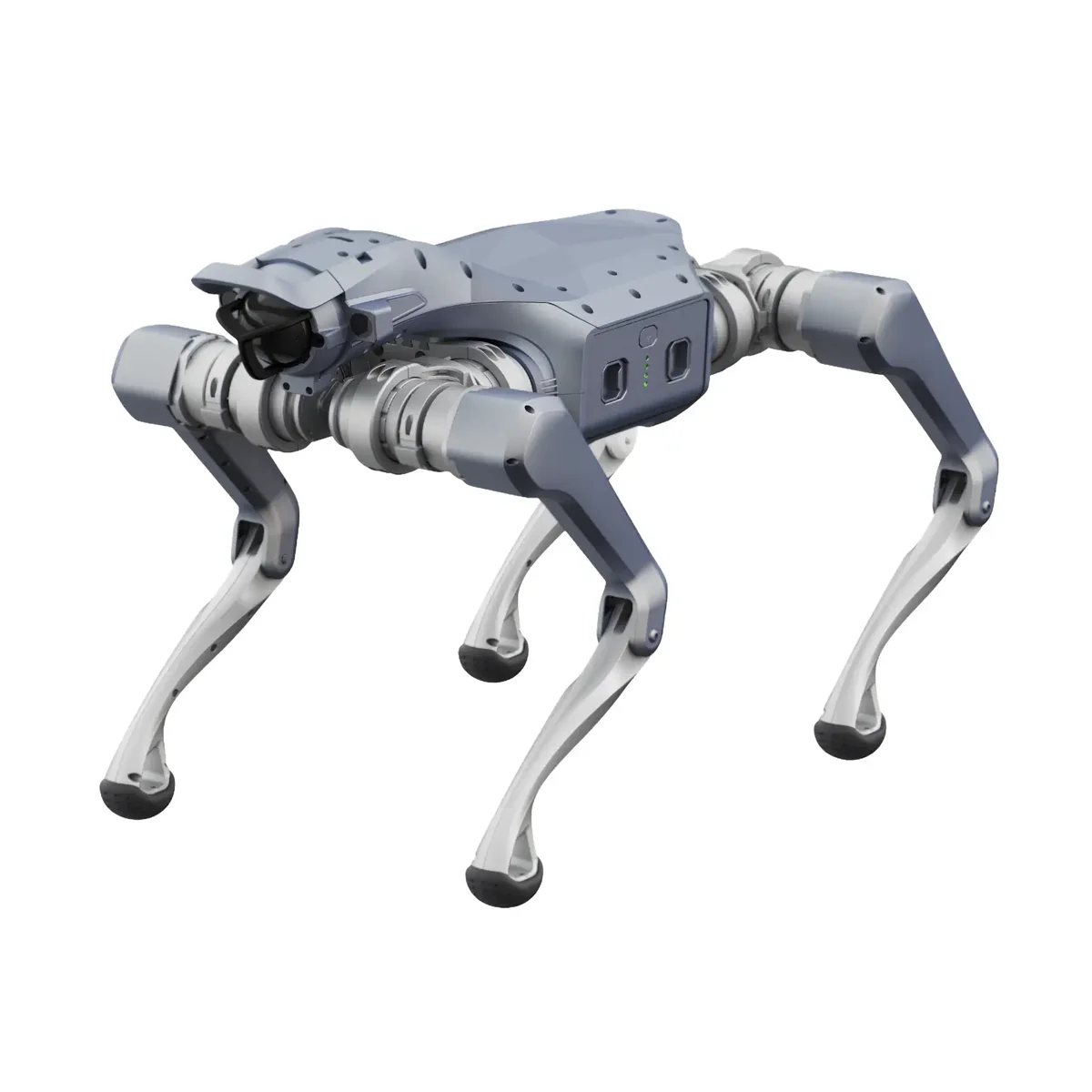
Model overview
Unitree As2 moves the compact quadruped category toward tougher mobile work. Weighing approximately 20 kg with battery, it combines stronger joints and longer endurance than lightweight consumer models while remaining far smaller than large industrial B-series robots.
Applications and practical role
As2 is a candidate for technical education, mobile development and supervised outdoor experiments where endurance and moderate payload matter. It should not be confused with a certified autonomous industrial inspection service without the required application hardware and software.
Design and key capabilities
Unitree quotes approximately 95 N·m maximum joint torque, a 648 Wh battery, more than four hours of unloaded runtime and an IP54-rated enclosure. ISS 3.0 following and developer interfaces broaden its uses; actual payload, computing and sensor equipment depend on AIR, PRO, X or EDU versions.
AI, offline functions and connectivity
The robot has onboard motion control and sensors; this alone does not prove that a generative AI model runs locally or works without internet.
As2 has an eight-core CPU and onboard sensing. Unitree lists 4G/GPS for PRO, X and EDU with user authorisation, not AIR. Support for large AI models does not mean a language model is preinstalled or runs offline.
Check the precise edition, available SDK, computing modules, app and internet requirements and any cloud or subscription terms. A demonstrated function may require additional software development.
Technical specifications
| Dimensions | 720 × 378 × 457 mm |
|---|---|
| Weight | Approx. 20 kg |
| Degrees of freedom | 12 |
| Maximum joint torque | Approx. 65–95 N·m by configuration |
| Maximum speed | Above 5 m/s |
| Unloaded endurance / range | Above 4 hours / above 20 km |
Technical values refer to the listed model or configuration; performance and equipment may vary by version and operating conditions.
What to check before choosing
Pay close attention to the exact variant, the continuous walking payload rather than a static load, and the distinction between unloaded and loaded endurance. IP54 is not waterproof immersion protection, and published terrain figures still require task-specific validation.