
Unitree A2-W
Unitree A2-W adapts the A2 industrial platform to wheel-legged motion, allowing longer rolling routes while retaining leg articulation for obstacles.
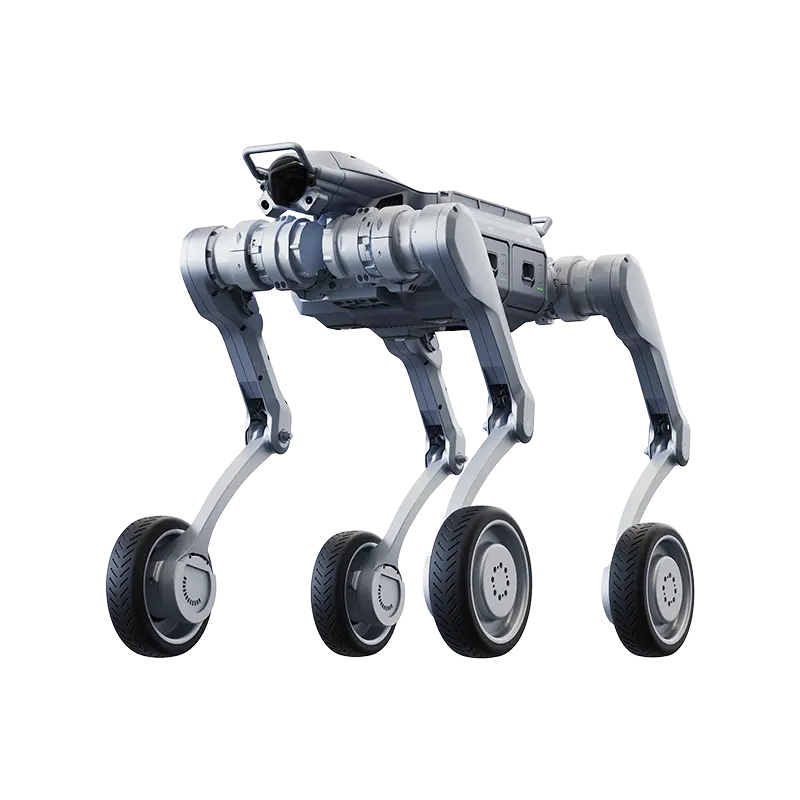
Model overview
Unitree A2-W adapts the A2 industrial platform to wheel-legged motion, allowing longer rolling routes while retaining leg articulation for obstacles. It is a heavy mobile robot of approximately 52 kg with sixteen driven joints.
Applications and practical role
The platform is relevant to infrastructure inspection, outdoor logistics trials and research where a robot must alternate between rolling and stepping. It is particularly worth comparing with the leg-only A2 when the mission includes long traverses on relatively suitable ground.
Design and key capabilities
Unitree combines the wheel-legged frame with dual batteries, strong joint motors and LiDAR/camera options. The manufacturer reports unloaded travel in the tens of kilometres under test conditions and identifies different sensor and protection arrangements for A2-W and A2-W PRO.
AI, offline functions and connectivity
The robot has onboard motion control and sensors; this alone does not prove that a generative AI model runs locally or works without internet.
For this model, Unitree has not clearly documented which advanced AI functions, if any, work fully offline and which rely on external computing or network services.
Check the precise edition, available SDK, computing modules, app and internet requirements and any cloud or subscription terms. A demonstrated function may require additional software development.
Technical specifications
| Dimensions | 900 × 440 × 625 mm |
|---|---|
| Weight | Approx. 52 kg |
| Degrees of freedom | 16 |
| Maximum joint torque | 180 N·m |
| Speed | 0–3 m/s; up to about 6 m/s |
| Protection | IP56; core components up to IP67 by configuration |
Technical values refer to the listed model or configuration; performance and equipment may vary by version and operating conditions.
What to check before choosing
Check the real path profile, wheel clearance, loaded range and exact sensor configuration. The baseline protection rating and the higher protection specified for some PRO components must not be presented as the same rating for the entire robot.